
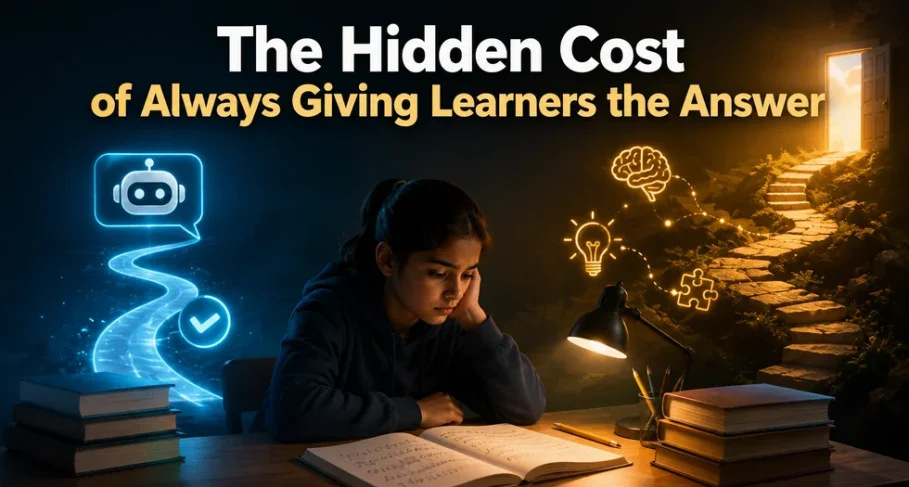
Imagine an eighth grade student trying to solve a math equation. If she were born a decade ago, she might have chewed on her pen and run her hands through her hair in frustration if she couldn’t solve it. Thankfully, she was born into the world of AI. Thankfully, she has AI chatbots standing by her side. She opens up her trusted chatbot, pastes the problem and gets a step-by-step solution in a jiffy.
This is the paradox sitting at the heart of the AI tutoring boom. The more readily and easily an AI answers difficult questions, the harder it is for kids to actually learn.
The Setup That Looked Like a Win
In 2024, researchers at Wharton and the University of Pennsylvania ran a study with around 1,000 high school students in Turkey. They were given math problems- some solved them on their own, some used a basic version of ChatGPT, while others used a tutor version that just gave hints instead of spoon-feeding answers. As many of you may have guessed it, at first glance students using ChatGPT and tutor versions scored better than those who did not use any AI tools.
The more interesting part is what happened next. When the researchers removed AI as an option, students who used the basic ChatGPT version struggled, and those who used the tutor version held their ground.
The paper concluded that freely available chatbots can substantially inhibit learning.
Come to think of it, there have been other papers that have come to similar conclusions. Another study found that reliance on AI reduced a student’s investment in learning, meaning that students were less able to solve the same kind of problem again once the AI wasn’t there.
Research Shows That Generating an Answer Yourself Instead of Being Simply Handed It, Produces Stronger Memory
Imagine a world-class footballer preparing for the World Cup final. Do you think he would practice all the easy shots to save his energy for the main day? or do you think he would strategically analyze his opponents’ game plan and practice hard so that on game day he is well prepared?
I can almost see you nodding your head at the latter. Good job! If you still don’t get it, just check with ChatGPT.
Ease during practice is a poor predictor of what sticks.
The “generation effect,” first documented by Slamecka and Graf in the 1970s shows that the information you produce yourself — even a wrong first attempt- creates a much stronger impact on your brain than information you’re simply given.
To simplify, a few years back I filed my taxes on my own for the first time. It was daunting and stressful but as I started getting into it and checking various doubts and errors with ChatGPT or Claude, I started getting a deeper and better understanding of my taxes. I may have had a wrong understanding of certain concepts but, thankfully, I now have a much better and deeper grasp of the same.
Students who attempt a problem before being taught the relevant concept — and fail at it — go on to out-perform students taught the concept first. A meta-analysis of more than 12,000 participants across 166 experimental comparisons found that Productive Failure students significantly outperformed peers in traditional, instruction-first classrooms.
A learner who tries three wrong approaches before the right one has mapped out why the wrong ones fail — that map is what later lets them improvise, adapt a method to a new context, or notice an unconventional angle.
What “Good” AI Tutoring Looks Like?
A good AI tool should be introduced to children as a guide. Versions that enable students to ask better questions and open up their minds to various possibilities within a concept. It should not spoon-feed answers to students.
Teachers or coaching institutes have an enormous opportunity to use these AI to aid learning by deploying personalized assistants that adapt to each child’s learning style, identify misconceptions and provide hints instead of the direct answer.
Imagine that same 8th grade student. What if instead of revealing the answer outright, the AI tools had nudged her towards the right answer by asking her questions like, “What have you already tried?” or challenged her existing assumptions. Let the child wrestle a bit with the nuances of the question and attempt to answer on their own. If she still can’t, then let AI step in to help.