A day out of school…
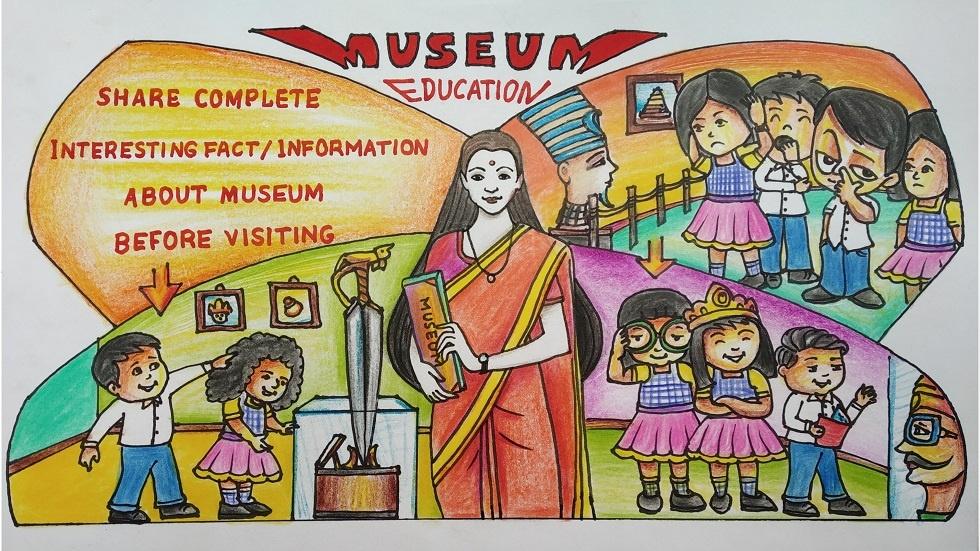
Would today’s children visit museums on a school day or even a holiday? They’ll probably make excuses. Which child would want to trudge winding staircases and long corridors of dusty old remnants of a bygone age? It’s boring, tiring, and uninteresting. The young minds would prefer playing their favourite video games or watching Netflix series. A part of you may be wondering if the kids are actually right. Are museums just dusty old places? They may be genuinely fascinating artefacts, but do they generate a connect with the young minds? Big, beautiful, impressive museums housed in grandiose buildings with manicured lawns and gardens don’t attract children like they used to.
I once asked my class why they hated going to museums? Their honesty was quite eye-opening. They went because they were told to. They were happier doing something else because the atmosphere of useums is funereal-like, dark and dingy; the displays useless and out of order. Half the times, the students don’t know what they are looking at. There’s no utility to the visit since it’s all on the internet anyway. They visit because “the teacher would mark us absent if we didn’t participate in the educational excursion”. Come to think of it, their aversion is quite understandable.
Setting the minds in motion…
Museums are temples of the muses. But, they need to outgrow the image of being mere storehouses for collection, preservation, and display. They need to be more than just cultural centres for the community. How can we make our museums kid-friendly given today’s children spending hours in the reality of a virtual world?
Since the early twentieth century, there has been an increasing acknowledgement of the importance of museums’ educational function. Way back in 1952, UNESCO staged a seminar in Brooklyn, USA on the role and effectiveness of museums.
Museum visits can provide memorable, immersive learning experiences that ignite the imagination. They are a form of art now, giving children dynamic opportunities to be exposed to novel experiences and cultures, customs, heritage, peoples, historical periods, and backgrounds in visually rich environments. Children can take ownership of their learning and spark their curiosities. This art-form gives a genuinely wholesome experience; a chance to connect the present with the past, and the future. Museums provide a space for reflection, experimentation, inspiration, interpretation, creativity and enjoyment, giving a broader understanding of time and space.
Therefore, it becomes imperative to bring museums into our curriculums in enjoyable and meaningful ways for our students. They need to be powerhouses instrumental to education rather than merely being display-houses. Children should relate to museums and their contents with joy and eagerness, rather than with awe and wonder. We need to make sure children have the same spring in their step and twinkle in their eyes as they do when visiting Disneyland or a Zoo.
Museum visits should be looked forward to. Even if the exhibits don’t attract them, children should be allowed to play around the premises. Their curiosities and boredom making them explorative; the environment always there to let them soak the ambience in and partake in the contextual mapping inadvertently. Such a visit gives an organic experience. Any information the children obtain is likely to include social, attitudinal, cognitive, and sensory associations which embed in their memory in a positive light. Any recollection of any facet of such a visit can facilitate the recall of the entire experience.
The local flavour…
In India, we can consider small, easily accessible local museums. Tedious, long-distance travel can be avoided. Such museums can highlight local history, folklore, art and crafts, flora and fauna, and mythology; concepts that children identify and are familiar with.
Many years ago, I was fascinated by one such unique museum in Slovenia dedicated to the craft of handmade laces. It came across as unusual because it recognises a 300-year-old tradition of bobbin lace making, indigenous to the small mercury mining town of Idrija. For decades, people have been taking pride in their local skill of intricately woven delicate laces that were a part of European royal households for centuries. Every June, workshops, demos, and competitions promote the town’s lace-making tradition and legacy.
We can have such a museum in Kashmir dedicated to the colourful kashida and Pashmina embroidery: the delicate thread work reflecting the life, customs, flora and fauna of the
local landscape. We can also have a mini-museum housed in tribal huts with Dhokra and wax figurines. Primitive simplicity and enchanting folk motifs using eco-friendly materials like beeswax, sand, and husk could connect children to the tribal craftsmen of Central India who have kept alive a 4000-year-old indigenous casting technique.
Our country has a rich tradition of art and artisans, crafts and craftsmen, folklore, and heritage in every corner. Children learn best through personal exploration and hands-on experiences. Curated museum visits by schools will foster partnerships and life long learning expeditions.
They can ask questions, make observations, reflect on experiences and draw their own conclusions. Senior children and teachers can also work as part-time guides during weekends to give children a sense of belonging to their local heritage, history, and culture.
An instrument of education…
Museum learning brings a proper understanding of subjects since it lets them experience things rather than memorise facts. Kids can be challenged to recreate paintings, sculptures and artefacts through creative role-plays and make-believe imitations using their bodies and simple props. They’ll have fun contorting themselves, clicking each other’s pics and posting them. Another fun activity could be giving each child 3-4 photos or pictures or postcards and letting them hunt for the objects and artefacts; like a treasure hunt. We need to let students take charge of their learning.
Textbooks should have better extra-curricular information boxes with locations and contextual links of places of heritage. Children can visit the places on vacation or take a virtual tour. For example, a link to a virtual tour of a museum in Bern, Switzerland, while studying Einstein’s physics theories can be a great addition to textbooks. The Bern museum offers an account of Einstein’s genius and his ground-breaking discoveries, illustrating the history of the time, the horrors of the Holocaust and an e-tour of the exhibition space that houses 550 original objects replicas, films, photographs and animations.
This mode of experiential learning will pave the way for a multidisciplinary approach to concepts. The aforementioned activities can complement formal education. They satisfy both individuals’ and collectives’ needs, taking into account local cultural variations, economy, and society. Thus, learning in, and learning through museums can strengthen the pedagogic role of informal education spaces.