
This website stores cookies on your computer. These cookies are used to improve your website experience and provide more personalized services to you, both on this website and through other media.
Accept
EdTechReviewEdTechReview
  • News
  • Trends
  • Insight
  • eLearning
  • Research
  • Dictionary
  • EdTech Voices
  • More
    • Data & Statistics
    • Reviews
    • AWS for Education
    • Events

    Resources

    • Infographics
    • Reports & Case Studies
    • Videos
    • Books
    • Webinar

    Needs

    • 1:1 Learning
    • 21st Century Education
    • 21st Century Leadership
    • 21st Century Learning
    • 21st Century Teaching
    • 3D Printing
    • More Tags

    For

    • Students
    • Teachers/Educators
    • Administrators
    • Entrepreneurs/Startups
    • Govt. Officials/Policymakers
    • Parents
Explore
Search
Contribute
  • Submit A Post
  • EdTech Trainers and Consultants
  • Your Campus EdTech
  • Your EdTech Product
  • Your Feedback
  • Your Love for Us
  • EdTech Product Reviews
ETR Resources
  • About
  • Mission/Vision
  • Team
  • Services
  • Testimonials
  • Authors
  • Sponsor
  • Partner
  • Advertise
  • Our Clients
  • Media Kit
  • Press Release
  • FAQ’S
Reading: [Tip for Educators] Designing Rubrics for Assessment
Aa
EdTechReviewEdTechReview
Aa
Search
  • News
  • Trends
  • Insight
  • eLearning
  • Reviews
  • Dictionary
  • EdTech Voices
  • Data & Statistics
  • Research
  • AWS for Education
  • Events
  • EdTech Voices
  • Tags
  • About
  • FAQ’S
  • Our Clients
  • Partner
Follow US
Home > Trend & Insight > Insight > [Tip for Educators] Designing Rubrics for Assessment
Insight

[Tip for Educators] Designing Rubrics for Assessment

Sudha
Sudha Published May 8, 2018
Share
5 Min Read
Designing Rubrics for Assessment
SHARE

Learning is measured to estimate and minimize the gap between ‘learned’ and ‘not learned’. 

AdvertisementWhy this Ad?

This gap is what determines the learner performance and defines success among them. To understand and develop such capacities, it is important to define and create valid rubrics for assessments. Assessments without rubrics is just like travel without destination.   Rubrics are as important as the assessments. Designing rubrics requires a complete preview to the learning outcomes. This article is an insight into how such rubrics can be developed for any type of assessments.

To begin with it is important to identify the types of assessment methods.  Generally they can be classified to

  •         Oral
  •         Written
  •         Technical
  •         Creative

The assessment guidelines are statements which allows probing into the assessment outcomes. 

No.

Assessment type

Assessment guidelines for building rubrics

1

Talk shows – Debates, discussions, JAMs, Mock works, Drama, Role-plays, etc.,

  1.       What do you expect from the topic?
  2.       Does it require learner presentation appropriately?
  3.       Does it require behaviour presentation?
  4.       Does it require emotional control
  5.       Does it require ethical view?

2

Written – Compositions, Letters, Dialogues, Articles, Projects, Research work etc.,

  1.       What are the guidelines for writing?
  2.       What type of writing is preferred?
  3.       What ideas do you expect in the writing?
  4.       How to check plagiarism?
  5.       What skill emphasis need to be laid down?

3

Creative – Collage, poetry, Slogan writing, Critical reviews, Cartooning, painting, music etc.,

  1.       Relevancy to the topic in hand.
  2.       Appropriate use of words or colours
  3.       Message promoted
  4.       Check on plagiarism
  5.       Uniqueness of the work

4

Technical – LMS, Apps, Presentations, Online works, Collaboration, Social media works etc.,

  1.       Type of work allocated
  2.       Type of performance level expected
  3.       Setting as per the technology opted
  4.       Competency development
  5.       Behaviour online


The guidelines are characteristics on what is the larger idea for the work that is incorporated into the assessments.  Once this is designed, it is important for the next level of setting, which is relevant for the subject and topic under consideration.  Rubric designs are based on the assessment specifications which can be based on four major categories of grading.  Grading preferably can be 4 – 6 for a better understanding of performance.  More the number of grades, specifics and overlaps are prominent and less number of grades categorisation becomes difficult.

Type

Marks

Grade

Specifications(minimum 5 – 6 to be provided in the rubrics design)

NA

0

E

Not attempted or no productive work done

Fair

1

D

Complied to any one of the specifications

Average

2

C

Complied to any two of the specifications

Good

3

B

Complied to any three of the specifications

Excellent

4

A

Complied to 4 or above as per the specifications

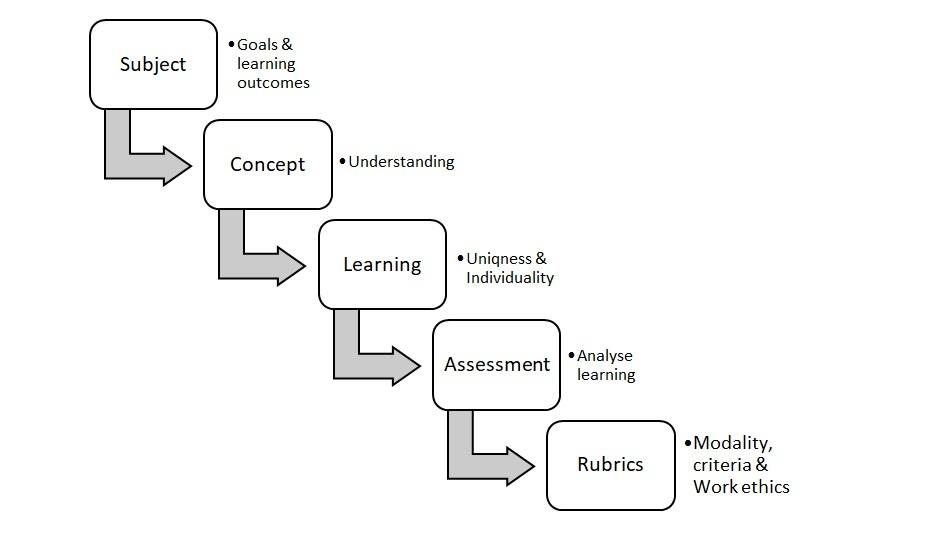
Rubric designing depends on the work done and the subject for which the said is constructed.  The flow of the content must have definite citations for further work and analysis.  The major flow of subject can be designed as follows to stream line the specifics for the rubrics.  All assessments need not carry rubrics.  The assessment designed with rubrics ensures the outcomes with criteria for analysis.

Design of Rubrics is mainly subject and task based.

https://www.teachingchannel.org/videos/designing-rubrics

Rubrics should finally give the total picture on gradations of student performance.  Some of the basic guidelines for design of rubrics can be obtained from the Carnegie Mellon University website.  The rubrics built should encompass the totality of the work done, step wise procedures that needs to be done for the given task, and the process through which the outcome has been achieved.  The basic format for design of such rubrics can be done as follows.
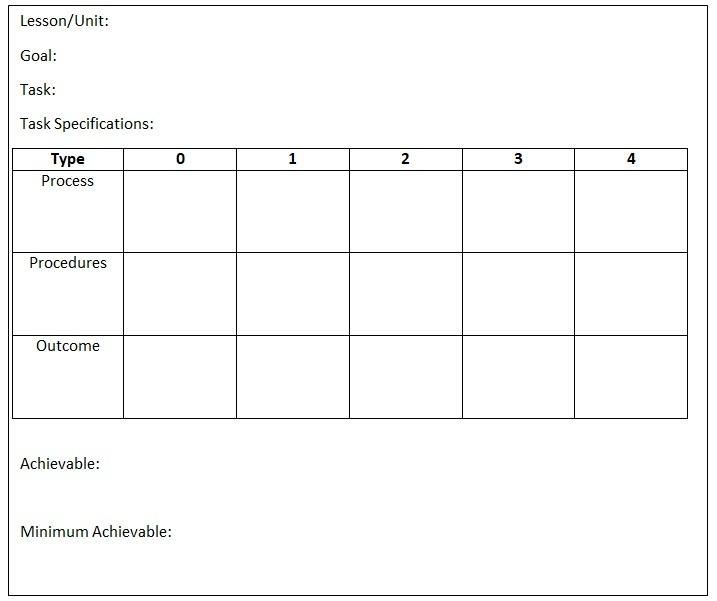
designing-rubrics-for-assessment

The learning outcome and possible feedback relies upon the rubric design.  It is observable that without the right design of rubrics, analysis and feedback becomes controversial.  Without the right feedback, learner growth and performance becomes a large question.  Aim to achieve the learning and learning gap is what we need to focus while developing rubrics.  Assessments for and of learning enhances and brings out the best when directed towards better outcomes.


TAGGED: 21st Century Teaching, Assessments, Teachers/Educators, Tips for Teachers/Educators, Tools for Teachers/Educators
Share This Article
Facebook Twitter Whatsapp Whatsapp LinkedIn Reddit Telegram Email Copy Link
Previous Article List of Over 200 Online CoursesMOOCs Starting in October 2015 15 Ways On How To Get The Most Of Your Online Course
Next Article Significance of Group Work in Higher Education 7 Design Parameters To Look For While Choosing A Business Simulation Software For Your Class
AdvertisementWhy this Ad?

Latest EdTech News To Your Inbox

Stay Connected

AdvertisementWhy this Ad?

Latest EdTech News To Your Inbox

Stay Connected

AdvertisementWhy this Ad?

You Might Also Like

Top 10 Early Childhood Care and Education ECCE Courses for Teachers in India 2026-27
News

Top 10 Early Childhood Care and Education (ECCE) Courses for Teachers in India 2026-27

Sponsored by UpEducatorsUpEducators
How to Build Educational Apps That Drive Real Teacher and Student Adoption in 2026
Insight

How to Build Educational Apps That Drive Real Teacher and Student Adoption in 2026

Sep 1, 2026
Why AI Lesson Planning Tools Are Only Solving Half the Problem
Insight

Why AI Lesson Planning Tools Are Only Solving Half the Problem

Aug 31, 2026
How Learning Gaps Can Be Identified Before Assessment AI-Powered Insights
Research

How Learning Gaps Can Be Identified Before Assessment (AI-Powered Insights)

Aug 28, 2026
The Future Belongs to Children Who Can Change Their Minds
Insight

The Future Belongs to Children Who Can Change Their Minds

Aug 26, 2026
Were Teaching Children for Jobs That Wont Exist Heres What We Should Teach Instead
Insight

We’re Teaching Children for Jobs That Won’t Exist, Here’s What We Should Teach Instead

Aug 15, 2026
Beyond the Examination Crisis Structural Reforms Must Take Precedence in Indias Education Ecosystem
Insight

Beyond the Examination Crisis: Structural Reforms Must Take Precedence in India’s Education Ecosystem

Aug 9, 2026
Education Crisis 2026 Protests Signal a Looming Economic Disaster for Indias Youth
Insight

Education Crisis 2026: Protests Signal a Looming Economic Disaster for India’s Youth

Aug 8, 2026
Show More
EdTechReviewEdTechReview

H433, 2nd Floor, Vikaspuri, New Delhi, India, 110018
Phone: 011 41321030

Follow US

Copyright © EdTechReview. All Rights Reserved.

  • Home
  • Advertise
  • Event Associations
  • Press Release
  • About
  • Services
  • Contribute
  • News
  • Trend & Insight
  • Data & Statistics
  • eLearning
  • Reviews
  • Research
  • EdTech Voices
  • Dictionary
  • Tags
  • Resources
  • Events
  • Courses
  • EdTech Product for Review
  • Sponsored/Paid Post Service
  • Our Clients
  • FAQ’S
  • Contact Us
  • Important Links
  • Sitemap
  • Terms of Use
  • Privacy Policy
newsletter
Join 100K+ subscribers!

Subscribe to our weekly newsletter that brings the latest EdTech news, trends, insights, reports, interviews, etc. for educators, school leaders, entrepreneurs, investors, & others.

loader
Zero spam, Unsubscribe at any time.
Go to mobile version
Welcome Back!

Sign in to your account

Lost your password?