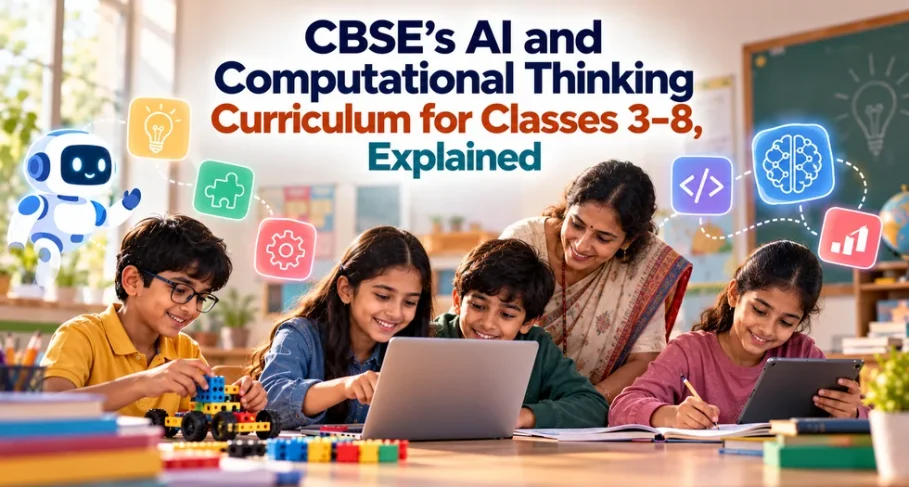
CBSE's Computational Thinking and Artificial Intelligence (CT & AI) curriculum is a framework that teaches structured problem-solving to children in Classes 3 to 5 and adds foundational AI literacy in Classes 6 to 8. It applies from the 2026–27 academic session and was launched by Union Education Minister Dharmendra Pradhan at Vigyan Bhawan, New Delhi, on 1 April 2026.
It reaches the 33,227 schools affiliated to CBSE [1], about 2.3% of India's 14,66,682 schools [2]. State boards decide for themselves. CBSE's stated aim, in its circular releasing the handbooks, is "creating AI-literate learners by 2030".
This explainer sets out what the curriculum teaches in each class, what CBSE has and has not made compulsory, how children are assessed, how teachers are being trained, and what schools and parents can do now. It is current to CBSE Circular Acad-70/2026 of 29 October 2026, which changed the plan for Class IX.
Key Takeaways
- Not a new subject. CT and AI are taught inside existing subject periods; CBSE "advised" schools to implement the curriculum.
- Classes 3 to 5: computational thinking only, inside Mathematics and The World Around Us (TWAU), about 50 hours a year, largely unplugged.
- Classes 6 to 8: advanced computational thinking, AI literacy and two projects a year, about 100 hours a year.
- No board exam for Classes 3 to 8. Assessment is continuous and formative.
- Free handbooks: a Student and a Teacher Handbook for each class, downloadable from CBSE.
- Class IX (2026–27): the CT & AI modules are not part of this batch's curriculum, under Acad-70/2026.
What Is Computational Thinking, and Why Does It Come Before AI?
CBSE's framework defines computational thinking as "a problem-solving approach comprising Decomposition, Pattern Recognition, Abstraction, Algorithm Design, Data Analysis, and Troubleshooting". In classroom terms:
- Decomposition: breaking a big problem into smaller parts.
- Pattern recognition: spotting what repeats or stays the same.
- Abstraction: keeping the details that matter and setting aside the rest.
- Algorithm design: writing clear, step-by-step instructions.
- Data analysis: collecting and reading information to answer a question.
- Troubleshooting: finding and fixing what went wrong.
These skills are not tied to a computer. Prof. Karthik Raman of IIT Madras, who chairs the expert committee behind the curriculum, put it plainly in The Indian Express: "CT is not coding, nor is it computer science."
The order is deliberate. Classes 3 to 5 build the reasoning; AI concepts arrive in Class 6, once that groundwork is in place. The approach follows NEP 2020, which says "mathematics and computational thinking will be given increased emphasis throughout the school years", and the National Curriculum Framework for School Education 2023, which lists decomposition, pattern recognition, abstraction and algorithms among the Middle Stage goals. For the wider idea of what an AI-literate student can do, see our explainer What Is AI Literacy, and Why Do Schools Need It?
Is the CBSE AI Curriculum Compulsory?
It is not a new compulsory subject. CBSE's launch circular, Acad-15/2026, "advised" all affiliated schools to implement it from 2026–27. CBSE's 2026–27 secondary curriculum document goes a step further and says schools are "directed to introduce" it, inside existing periods and "without reliance on specific platforms, devices, or additional instructional time".
What that means in practice:
- Time: a suggested 50 hours a year in Classes 3 to 5 and 100 hours in Classes 6 to 8. CBSE calls these flexible, and "schools can go beyond the allocated time".
- Books: CBSE has published a Student Handbook and a Teacher Handbook for each class from 3 to 8, twelve free PDFs. They are "not designed as textbooks, but rather as a companion to the NCERT Mathematics textbooks".
- Platforms: schools choose their own, and the framework recommends free and open-source tools.
- Language: the handbooks are in English. At the launch, Pradhan called for the curriculum to be made available in Indian languages.
Classes 3 to 5: Thinking Skills Inside Maths
There is no AI in Classes 3 to 5. Computational thinking is woven into Mathematics and TWAU and taught by the regular subject teachers "using special worksheets and handbooks". The handbooks build four threads: abstract thinking, pattern recognition, decomposition and algorithmic thinking.
The activities look more like puzzles than computer lessons:
- Class 3: a Caesar cipher, in which children shift letters to write and crack secret messages, an introduction to basic cryptography.
- Class 4: Coin Flip Magic, a trick that introduces parity and error detection, and a sorting network chalked on the floor that children walk through to put numbers in order.
- Class 5: finding the one fake weight among nine using only a balance.
CBSE describes this stage as "largely unplugged", with no computer required. It is not entirely screen-free: one competency covers the parts of a computer, input and output devices, file management, internet safety, educational software and block-based coding such as Scratch, where a school has the equipment.
Classes 6 to 8: CT, AI Literacy and Two Projects
From Class 6 the suggested 100 hours a year split three ways: 40 hours of advanced computational thinking, 20 hours of introductory AI concepts and 40 hours of interdisciplinary projects, which means two projects of 20 hours each. Subject teachers take the CT resources, the computer teacher takes the AI-literacy part, and the computer teacher assesses the projects.
Each year has four AI chapters of about five hours each:
- Class 6: introduction to AI and everyday examples; basic data concepts; simple pattern recognition and decision-making; ethics and digital responsibility.
- Class 7: AI domains such as classification, regression and clustering, computer vision, natural language processing and data science; AI in industries; data visualisation and analysis; ethics and AI bias awareness.
- Class 8: the AI project lifecycle, "Define Problem, Collect Data, Test AI Tools, Reflect and Improve", with hands-on work in "simple no-code AI tools". The Class 8 student handbook names Teachable Machine and Machine Learning for Kids as examples.
CBSE's sample projects tie AI to other subjects: "Exploring Weather and its Impact across States" in Class 6, "Nutri-Quest: Weekly Food Planner" in Class 7 and "Sports Participation and Performance Data" in Class 8. At its April 2026 teacher webinar, CBSE marked a fuller project list with rubrics as "coming soon".
CBSE CT and AI Curriculum: Class-by-Class at a Glance
| Class | Focus | Sample activity | Suggested time | How it is assessed |
|---|---|---|---|---|
| 3 | Computational thinking inside Maths and TWAU | Caesar cipher secret messages | About 50 hours a year | CT puzzles in written tests, group activities, teacher observation journal |
| 4 | Computational thinking inside Maths and TWAU | Coin Flip Magic; a floor sorting network | About 50 hours a year | CT puzzles in written tests, group activities, teacher observation journal |
| 5 | Computational thinking inside Maths and TWAU | Finding the fake weight among nine | About 50 hours a year | CT puzzles in written tests, group activities, teacher observation journal |
| 6 | Advanced CT; everyday AI, data, patterns and ethics | Project: Exploring Weather and its Impact across States | About 100 hours a year | Written and practical work, projects, reflections, group discussions |
| 7 | Advanced CT; AI domains, AI in industries, data visualisation, bias | Project: Nutri-Quest: Weekly Food Planner | About 100 hours a year | Written and practical work, projects, reflections, group discussions |
| 8 | Advanced CT; the AI project lifecycle with no-code tools | Project: Sports Participation and Performance Data | About 100 hours a year | Written and practical work, projects, reflections, group discussions |
How Is the CT and AI Curriculum Assessed?
There is no board exam for Classes 3 to 8. The framework says assessment should "move away from traditional summative assessment to continuous, formative, and competency-based assessment".
- Classes 3 to 5: written tests with CT questions and puzzles, group activities such as treasure hunts, and a teacher observation journal, linked to Mathematics and TWAU.
- Classes 6 to 8: the same, plus practical examinations, thematic projects, reflections and group discussions.
CBSE has not published marks weightage or a report-card format for the curriculum. Its webinar for teachers stated that there is "no expectation of computer access for assessment".
What Changes for Classes 9 to 12?
For students now in Class IX (2026–27), the CT & AI modules are not part of the curriculum. Circular Acad-70/2026 of 29 October 2026 says that, "to align the introduction of this curricular area with the implementation schedule", the "Modules of CT & AI" in Class IX "shall not be the part of the curriculum for these batches". The same applies to these students when they reach Class X in 2027–28. Students now in Class X continue under the old scheme.
Many reports published before 29 October describe the Class IX modules as compulsory. They predate this circular.
AI itself has not left the secondary classes:
- Artificial Intelligence (417) remains one of the 22 skill subjects open to Class IX in 2026–27. A student who chooses it sits the board exam in that subject in Class X in 2027–28.
- Artificial Intelligence (843) continues as a subject in Classes XI and XII.
- NCERT's new module, An Introductory Module on Computational Thinking and Artificial Intelligence for the Secondary Stage (Grades 9–12), first edition October 2026, plans 20 class hours and assumes no previous knowledge. Its five units run from AI in everyday life to how machines learn, when AI gets it wrong, data rights and prompting.
CBSE's 2026–27 secondary curriculum document still plans CT & AI as a compulsory subject from 2027–28, with a Class X board exam listed for 2028–29. That is a plan in a curriculum document, not a notification, and Acad-70 shows the schedule can move. Schools should follow the circulars.
How Are Teachers Being Trained?
CBSE has made "Computational Thinking and Understanding AI" its teacher-training theme for 2026–27. The main routes:
- Handbooks: every class has a Teacher Handbook alongside the Student Handbook, written by an expert committee that includes Prof. Raman, with materials produced with the Centre for Creative Learning (CCL) at IIT Gandhinagar.
- District Level Deliberations: voluntary, offline, one-day sessions for about 40 teachers each, run by lead schools and Sahodaya school complexes and counted as 6 CPD hours. CBSE said in August 2026 that more than 450 had been scheduled.
- 3030 Eklavya: an online series with CCL, IIT Gandhinagar, from 15 August 2026, for teachers and students of Class 6 and above. It is voluntary, and registration is free but compulsory. Eight sessions run live on Sundays at 4 pm in Hindi; each episode counts as 3 CPD hours, and a certificate costs ₹200 plus taxes.
- CBSE's webinar for teachers of Classes 3 to 8 on 28 April 2026.
- NCERT's CIET courses: "Leveraging AI for Transforming School Education" (January 2026) and "Robotics and AI in Education" (February 2026).
The Ground Reality: Devices, Internet and Teachers
India's school data shows why CBSE kept the design low-tech. Under UDISE+ 2025–26, 67.4% of schools have internet access, up from 63.5% a year earlier, and 69.9% have a computer facility [3]. Working desktops are scarcer: 36.5% of all schools have functional desktops or PCs, including 25.5% of government schools and 63.2% of private unaided schools [2]. Government schools make up 68.5% of the total [2]. India has 1,02,73,020 school teachers [3].
UDISE+ does not split its figures by board, so there is no CBSE-only number. CBSE's answer to the gap is the design itself: activity-driven lessons, no required platform or device, and assessment that does not need a computer.
Not everyone is convinced. R Ramanujam of Azim Premji University wrote in The Indian Express that "the digital divide in the country is vast, and our teachers are ill-prepared and undereducated on AI and digital tools", and that the curriculum "could add to the information overload". Prof. Raman's reply to the burden argument was that "content burden is a question of priority". At the launch, CBSE Chairman Rahul Singh said, as reported by Business Standard: "We want AI to be demystified and the curriculum will be revised as per feedback from schools."
What Schools and Parents Can Do Now
For schools:
- Download the Student and Teacher Handbook for each class from CBSE's CT & AI page on cbseacademic.nic.in.
- Map the Classes 3 to 5 activities to the NCERT Mathematics chapters they accompany, and plan the hours inside existing periods.
- In Classes 6 to 8, settle who teaches what: subject teachers for CT, the computer teacher for AI literacy and the projects.
- Nominate teachers for a District Level Deliberation and the 3030 Eklavya series; both count toward CPD hours.
- Choose free and open-source tools where possible, as the framework recommends, and check what the no-code tools need before the Class 8 projects begin.
- Tell Class IX families what Acad-70 means for them and which skill subject each student is taking.
For parents, four questions to ask the school:
- Which subjects and periods carry computational thinking, and how much time does it get?
- With no exam, how is my child's progress recorded and shared?
- In Classes 6 to 8, which AI tools are used, and what information do they collect from children?
- In Class IX, which skill subject has my child chosen?
Beyond CBSE: What States Are Doing
The CBSE framework does not bind state boards, but some are moving on their own. In Kerala, KITE has put AI into the state's ICT textbooks: computer vision in Class 7, machine learning in Class 8 and large language models and prompting in Class 9, with robotics in Class 10. Tamil Nadu has reportedly piloted an AI and emerging-technology curriculum in about 5,000 government schools and plans to extend it to Classes 6 to 8 in all government schools, with no date announced [4].
Frequently Asked Questions
Is AI a compulsory subject in CBSE schools from Class 3?
No. There is no new subject. Computational thinking is built into Mathematics and TWAU in Classes 3 to 5, and AI literacy is added in Classes 6 to 8, inside existing periods. CBSE advised schools to implement the curriculum from 2026–27, and its curriculum document directs them to introduce it.
Will my child need a computer or tablet for the CT and AI curriculum?
Not in Classes 3 to 5, which CBSE describes as largely unplugged. Classes 6 to 8 use simple digital and no-code tools where the school has them. The framework does not depend on any platform or device, and CBSE has said assessment does not require computer access.
Will children learn coding under the CBSE AI curriculum?
Computational thinking is not coding. It teaches problem-solving skills such as decomposition, pattern recognition and algorithm design. Block-based coding such as Scratch appears as one competency in the early classes, and Classes 6 to 8 use no-code AI tools such as Teachable Machine.
Is there an exam for computational thinking and AI in Classes 3 to 8?
There is no board exam. Assessment is continuous and formative: CT puzzles in written tests, group activities and a teacher observation journal in Classes 3 to 5, with practical work, projects, reflections and discussions added in Classes 6 to 8.
What happens to CT and AI in Class 9 in 2026–27?
Under CBSE Circular Acad-70/2026 of 29 October 2026, the CT & AI modules are not part of the curriculum for students in Class IX in 2026–27, or for the same students in Class X in 2027–28. Artificial Intelligence (417) remains available as an optional skill subject.
Where can schools download the CBSE CT and AI handbooks?
On CBSE's academic website, cbseacademic.nic.in, under Computational Thinking and Artificial Intelligence (CT & AI). There is a free Student Handbook and Teacher Handbook for each class from 3 to 8, designed as companions to the NCERT Mathematics textbooks.
Who teaches computational thinking and AI in CBSE schools?
In Classes 3 to 5, the regular subject teachers teach it within Mathematics and TWAU. In Classes 6 to 8, subject teachers take the computational-thinking resources and the computer teacher takes the AI-literacy part and assesses the projects.
References
[1] List of Affiliated Schools, CBSE SARAS: https://saras.cbse.gov.in/SARAS/AffiliatedList/ListOfSchdirReport
[2] UDISE+ 2025-26: https://dashboard.udiseplus.gov.in/report2026/static/media/UDISE+2025_26_Booklet_nep.94ceae1e8c2210549d21.pdf
[3] The Union Ministry of Education Releases the Report on UDISE+ 2025-26: https://www.pib.gov.in/PressReleasePage.aspx?PRID=2282141
[4] Tamil Nadu to roll out AI & emerging technologies curriculum across all govt schools: https://educationpost.in/news/education/tamil-nadu-to-roll-out-ai-emerging-technologies-curriculum-across-all-govt-schools